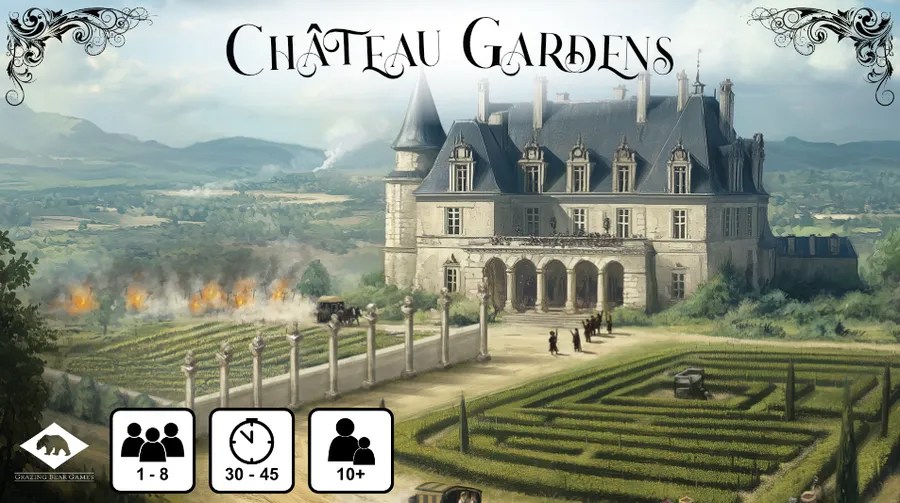
Image taken from https://boardgamegeek.com/image/8482775/chateau-gardens
Designer: Zach Sullivan
Publisher: Grazing Bear Games
Artist: Diego Sanchez
I’m just going to start by saying this may be one of the best blank and write experiences I’ve ever had. The game design (can only speak for the solo mode) is superb; mechanically, the game is simple and easy to understand, but the way the gameplay functions with standard playing cards is impeccable. Not only is this game creative and mechanically original, it also is strategic, thought-provoking, and just plain fun. While not being super deep, there are still interesting decisions to make, and the spatial puzzle is exceptionally satisfying. There’s also a press your luck element that adds another layer.
To play, all you need is a player sheet, a writing utensil, and a standard deck of cards. Once the cards are shuffled, four are removed and then the rest are used for play. Each player begins the game with one suppléant card (in the solo game you start with two) which can be used at any point in the game to override the revealed card from the deck. Before the game begins, each player also places a supply shed on their board which is one square that’s worth +1 points when a shape is drawn adjacently (as in if a three shape is drawn next to the shed, it’s worth four points).
The rules are pretty simple but oh so clever. Each round, a player reveals one card from the deck and each player must draw the corresponding shape on their player sheet (thematically, you’re adding architectural pieces to the garden). The number of the card indicates the number of squares that must constitute the polyomino shape as well as the number of points that shape is worth. The suit of the card provides the rules for placement and shape. Diamonds may be placed anywhere on the grid but must be entirely in a straight line. Hearts also have no placement restrictions but must include one 90-degree bend. The darker suits have no restrictions on shape, but they do on placement. Spades can be any shape but must touch the outside border, and clubs can be any shape but must not touch the outside border.
Most standard placement rules apply: nothing can overlap, nothing can be drawn diagonally, you have to be able to fit the total correct number of squares in the shape, etc. One interesting rule is that shapes can be placed anywhere and do not have to be touching other shapes. The other important caveat is that singe square shapes cannot be adjacent to other one-square shapes. So, no single square shapes (see next paragraph) can be placed adjacent to the aforementioned supply shed since the shed is already a singular square.
Since there are no value one cards in a standard deck, these single-squared shapes come from face cards. Along the same line as the numbers, each face card provides unique scoring. Jacks are worth five points for each orthogonal side touching a shape, but the outer grid limit does not count. Queens are scored as three times the difference between the highest and lowest adjacent shapes’ values (probably the most confusing but it’s highest adjacent value minus lowest adjacent value times three). The kings are worth the sum of all their adjacent shapes. Last but not least are the aces which are the best! They allow you to extend your garden grid one column or row in a single direction of your choice.
If you are unable to draw a shape, you do not add anything to your garden and will receive double the card’s value as negative points at the end of the game.
At any point after drawing and scoring but before the next card is revealed, a player can choose to stop. From this point on, nothing gets added to your board, but you also don’t accumulate any negative points for any shapes you are unable to place in your garden.
Once each player has chosen to stop or the deck runs out, the game ends and the player with the most points wins! In the solo game, you can play as a beat your own score type game, or you can play with challenges. In this second mode, you select one of three difficulty levels and see if you can achieve the number of challenges required. My first game I played as beat my own score since I was learning, but now I prefer the challenges and difficulty levels. There is one challenge I have yet to accomplish, but it’s fun to have something to work toward each game.
As I was writing this review, I realized that I missed the “choose to stop” aspect of the game and just went through a whole deck to see how well I could do (reading is hard). This is probably why I haven’t been able to achieve that one challenge! After playing the correct way, I actually think I like going through the whole deck and seeing how high of a score I can receive and/or how many challenges I can accomplish, but I appreciate that I have options now. 😂
Somehow (not trying to be mean but it defies my usual logic) I find this game highly replayable while not having large variation(s) between games besides the randomness of the cards. Each game is essentially the same, and mechanically is played identically, but the inherent randomization of the cards and the enjoyment of the ever-changing unique puzzle makes this game very crave-worthy for me. It’s fun, satisfying, tactical and strategic, quick, and simple, so it’s very easy to get to the table and enjoy! From experience, it’s even easy to play while something is on in the background, and it’s effortless to start and stop if needed.
If you can’t tell, I love this game and highly recommend it to anyone who likes spatial puzzles and/or blank and write games. While I haven’t played multiplayer and can’t speak to that experience, the solo mode is fantastic, and due to the simultaneous turns, I could see this working well in large groups without a massive increase in play time. I will happily teach this game to other players, but if I only ever play solo, I will be more than content. Thanks, Zach, for making such an incredibly simple but truly lovely puzzle of a game. I wish I was more eloquent and could put into words the happy, fuzzy, satisfying feeling I get when I play, but I’m not that skilled, so I’ll leave it at this: it’s phenomenal and you should check it out!
 The Adventures of Yogi Bear and Delaware
Leave a comment