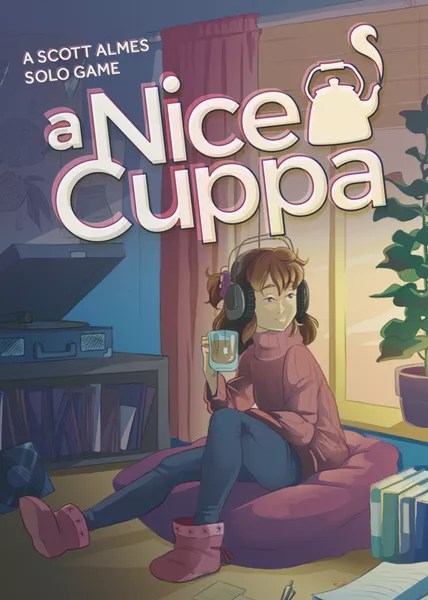
Image taken from https://boardgamegeek.com/image/8168180/a-nice-cuppa
Designer: Scott Almes
Publisher: Button Shy
Artist: Andrea Ivetic Vicai
I’m a Scott Almes fan, and I also like solo Button Shy games (at least most of the ones I’ve played), so I was already intrigued by this game, but once I saw the theme, I was sold! I love tea, so why not have a small, quick game about making a cup of tea?!
The mechanics of A Nice Cuppa are very easy to understand, but there are some fun and interesting strategic elements as well. To set up, you shuffle and lay out all seven (numbered one through seven) of the Tea Cards with their focused side up. Each tea card has a focused side and a distracted side. The distracted side isn’t necessarily bad, you just receive fewer points at the end of the game for distracted cards. After the Tea Cards are laid out, you shuffle the Worry Cards and place one face down underneath each Tea Card (there will be a few left over that won’t get used that game).
Game play takes place over a series of eight turns, and each turn you complete certain steps in a specific order. First, you select one face down Worry Card to flip face up. Then, you perform the action of each face up Worry Card from left to right, resolving each action completely before starting the next. Once that is complete, you flip each Tea Card above a face up Worry Card, so you either flip from focused to distracted or from distracted to focused. Any Worry Card that is then below a focused Tea Card gets removed from the game. At the end of your turn, you also have the option to swap two adjacent Tea Cards. On your last turn, there will not be a face up Worry Card to flip, so you skip that step and complete the rest as usual, and then proceed to scoring.
Your final score is contingent on how many focused Tea Cards you have, how many are distracted, how many Worry Cards remain, and how well you were able to organize the tea cards in numerical order. To calculate your score, you discard all Tea Cards to the left of Tea Card #1 but keep Tea Card #1 and each subsequent Tea Card that forms an unbroken ascending sequence. Any Tea Cards remaining after that sequence also get discarded. You then score the remaining line of Tea Cards: focused cards are worth two points each, distracted are one point each, and each lingering Worry Card is minus one point.
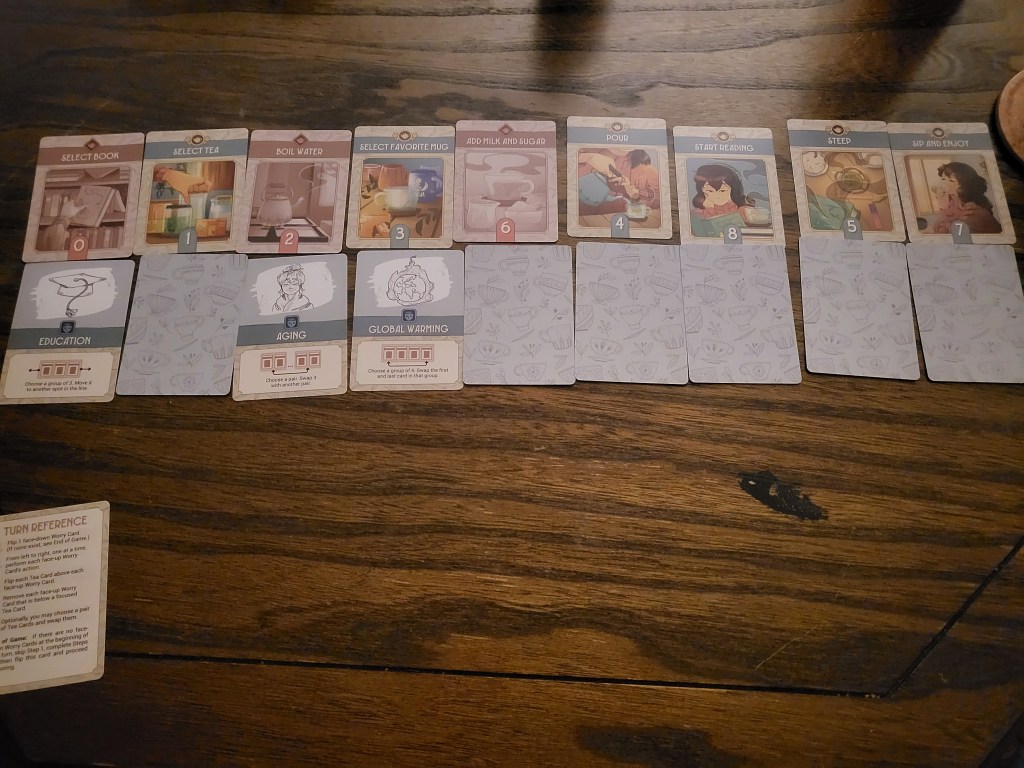
The Seasonal Stresses expansion adds challenge (Stress) cards (one for each season) that are thematically related to events during that season. Each Stress Card has a requirement that needs to be met, but once you have succeeded in achieving that, you receive an immediate reward. Stress Cards score minus three points at the end of the game if still in play.
The expansion entitled (pun intended) A Good Book adds two Tea Cards and three Worry Cards. During setup, these cards get shuffled with their respective cards from the base game. The addition of the two Tea Cards means that instead of seven cards, you will have nine cards in your row that need to be organized. The three Worry Cards just add more variation.
It is also important to mention that the base game and the A Good Book expansion have two difficulty levels, and there are score comparison charts for both levels included in the rules.
The base game of A Nice Cuppa is honestly, well, a nice cuppa. It’s cozy, straightforward to learn and mechanically very easy to play, but there are a lot of unique and enjoyable tactical decisions to make and strategies to experiment with. There is a satisfying puzzle underneath the surface level simplicity. Deciding which cards to move where and when is intriguing, and each decision requires quite a few considerations. It’s tempting to get rid of the Worry Cards as soon as you can, but you can’t get rid of them too quickly or too simultaneously because then you won’t have enough opportunities to move your cards.
The game plays quickly and smoothly, and only takes up as much space on the table as you need for your two rows of cars. The included reference card is also very helpful in outlining the steps of each turn and showing the method for scoring at the conclusion of the game.
The Seasonal Stresses expansion increases the difficulty (in my opinion) due to the challenge requirement, but it doesn’t seem to be too much of a distraction (game pun intended) from my experience. I often found myself focusing on that requirement early in the game which was good for getting it out of the way, but most of the rewards would likely be more useful towards the middle and end of the game.
A Good Book turns up the difficulty some as well, and obviously the game gets slightly longer since there are two more turns, but I think it increases the strategy level and challenge level of the puzzle, which I love. I will definitely incorporate the Seasonal Stresses into some games, but I will almost assuredly always play with A Good Book unless I’m in a major rush.
Artistically, I find this game easy on the eyes with its more muted colors, but it’s still beautiful and has a lovely table presence. The mechanics aren’t particularly integrated into the theme, but I think the overall theming is very well done and spot on for a game about making a cup of tea and reading a good book.
The first game I played, I actually managed to get all seven cards in the appropriate sequence, and I had a moment of “is that it?”, but then once I added in the expansions, and even as I’ve gone back and played the base game again, I’ve never gotten more than five or six cards in a row. I just had some serious beginner’s luck. 😂
All in all, I found A Nice Cuppa to be a delightful experience. I really enjoyed the tactical puzzle it produces, and it’s easy to get to the table since it’s a quick and streamlined game. I look forward to the two new expansions they will be releasing in the next few months. Now I just need to play while I drink a cup of tea! And then maybe read a good book?
 The Adventures of Yogi Bear and Delaware
Leave a comment