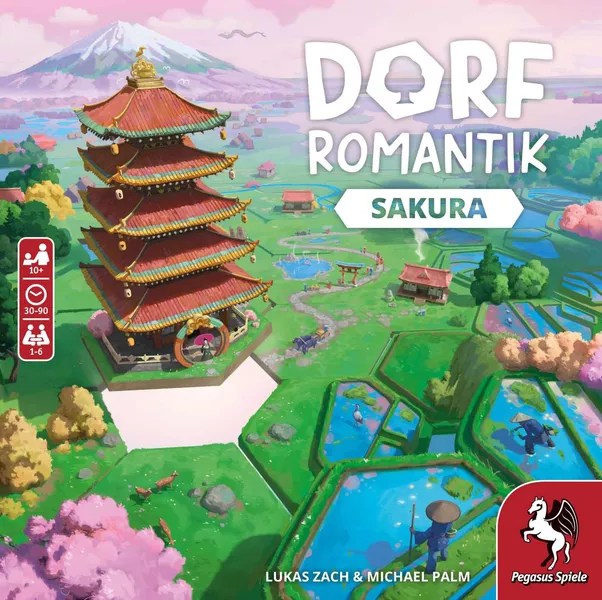
Image taken from https://boardgamegeek.com/image/8305438/dorfromantik-sakura
Designers: Michael Palm, Lukas Zach
Publisher: Pegasus Spiele
Artist: Paul Riebe
While I haven’t reviewed it yet, the original Dorfromantik was in my top five solo games for quite some time, so when I saw a new version was being released, I preordered it immediately! I’ll get into more specifics, but while Dorfromantik: Sakura (here on out, Sakura) is similar to the original, there are some design changes and additions to make it feel different enough. As with the original, I enjoyed my time playing through the campaign in Sakura and appreciate the attempts to make it a unique experience while still keeping the game true to its original form.
The first game in Sakura is essentially identical to the starting game in the original, and the rule book actually indicates that you can skip the rules (until the campaign pages) if you already know how to play. Aesthetically, the art and some terrain types are different, but the campaign is really where Sakura starts to branch off from the original.
Some aspects of the campaign are similar, and some are distinct. I won’t reveal any specific spoilers, but I do want to try to provide general information on some of the differences so you can decide if this is a game for you (especially if you have the original already).
In the campaign, there are quite a few special elements that weren’t included in the first game. There is one major mechanic that gets added (cherry blossoms) which provides additional strategic considerations and goals throughout each game. The cherry blossoms also have their own path on the campaign sheet. In the same vein, there are thematic integrations into specific scoring conditions that I found fascinating and well designed. A new type of task is also introduced which I actually really enjoyed, and some unique task numbers can eventually be incorporated. A few new secondary terrain types get added, and there are some innovative achievements to unlock and unique goals to work towards. Sakura also adds some unlockables that can be utilized in each game that affect tiles and tasks in ways the original never did.
My one major complaint is that towards the end of the campaign, trying to juggle everything that was unlocked got a little overwhelming. Not only did the necessary table space significantly increase, but keeping everything organized, trying to remember when to score specific things, and facilitating the use of helpful unlocked items created some brain overload. Truthfully, I just accepted that I’d miss things and did my best, but starting a game became a little daunting.
Overall, I enjoyed my experience with Sakura and I do feel the elements of the campaign differ enough from the original to warrant having both if you thoroughly enjoyed the original and working through its campaign. If you only play the base game and/or if you aren’t as interested in the campaign, I don’t think owning both is necessary. Thematically, artistically, and mechanically, though, I do prefer Sakura to the original. While I still plan to keep and play the original, I found Sakura slightly more complex, engaging, and beautiful.
 The Adventures of Yogi Bear and Delaware
Leave a comment