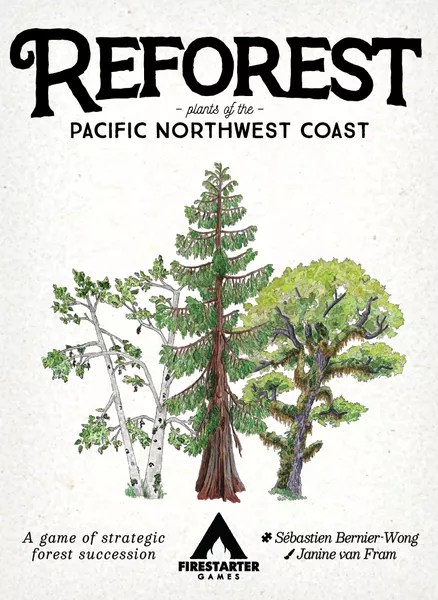
Image taken from https://boardgamegeek.com/image/8077548/reforest-plants-of-the-pacific-northwest-coast
Designer: Sébastien Bernier-Wong
Publisher: Firestarter Games
Artist: Janine van Fram
If you read nothing else, know this: Reforest deserves a chef’s kiss 👌, and this review doesn’t do the game enough justice.
In Reforest, you are growing a forest ecosystem by “arranging and evolving a synergistic collection of plant cards” (as the rule book states). To do this, you play plant cards from your hand into a pyramid shaped tableau. The game is played over a series of three rounds, and the person with the most points at the end of the game wins. In the solo game, you play to score higher than the total value of the plants in your game (standard mode) or if you want something more challenging, you can also add any unearned round-end visitor points (we will come back to this). As I’ve only played this solo, I actually really like this method for a win/lose condition. I was expecting a beat your own score kind of game, but I love that you’re trying to beat the deck with the deck itself. It makes everything a little more strategic.
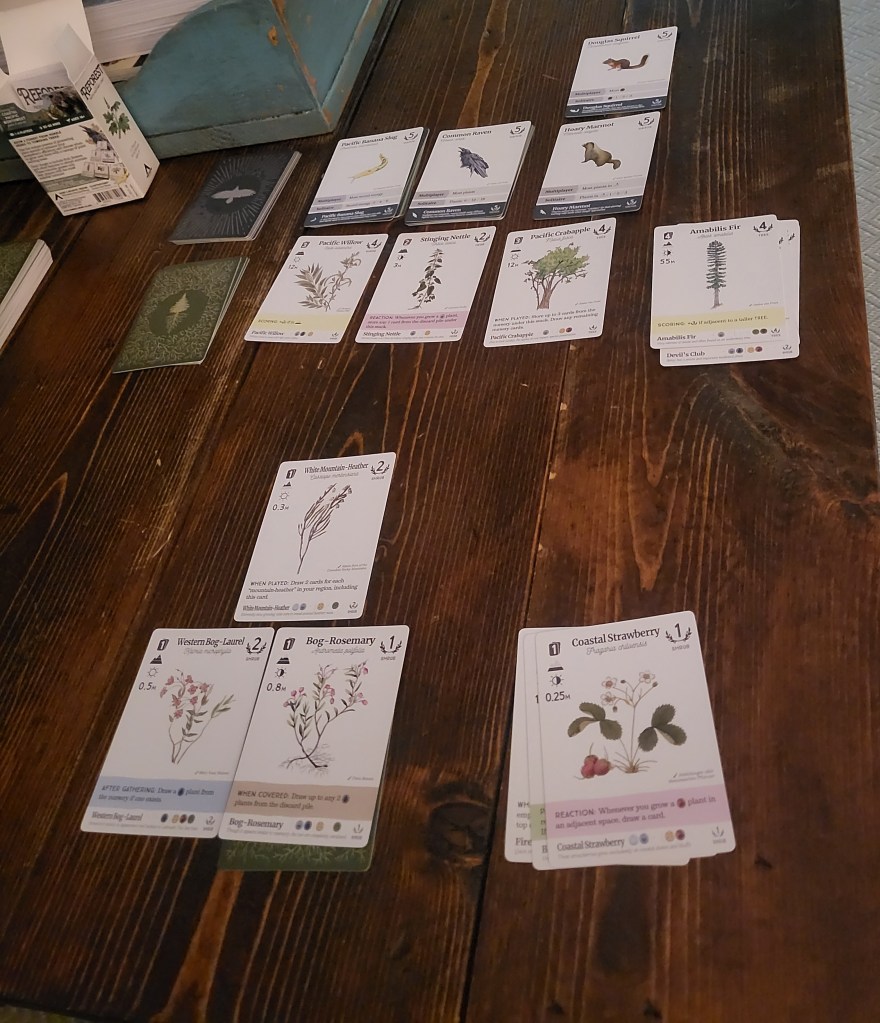
To start the game, you create the plant deck. The total number of cards depends on the number of players, but there are 91 total plant cards, so there is a lot of variety, especially solo. Then, each player receives five of those plant cards and three others are placed face up to create the nursery. Besides the plant deck, there is a deck of ten visitor cards which also gets shuffled and three cards get placed face up (one for each round). Then, a certain number of cards from the plant deck get tucked under the first and second visitor card (you’ll see why this is important later).
On your turn, you have two options: either gather plants or play a plant. To gather plants, you draw up to two cards from any combination of the deck and/or the nursery. To play a plant, you pay its cost and add it to your region. There are a few interesting things to note about playing a plant:
1) Since you have a pyramid shaped tableau, there are three different elevations at which you can play a card. The first card has to be placed at the lowest elevation, but each subsequent card just has to be adjacent to a previously placed card, and each plant has specific elevation restrictions.
2) To pay for a plant, you must discard cards from your hand and/or discard stored energy (we will come back to this).
3) You can cover and stack plant cards. Plants may be played on top of other plants if they are taller than the existing plant. When covering a plant, you’re granted a succession discount, meaning that stacking cards costs less than placing them in an empty space. You subtract the value of the existing card with the new card to get the net cost. For example, if the cost of the current card is 1 and the card you want to play costs 3, then you only have to discard two cards (math!).
4) Now we’re coming back to the stored energy! When you stack a card on top of a plant that requires complete sunlight, that plant turns into stored energy. If you cover a plant that only needs partial sunlight, it persists and becomes part of the understory.
5) Each card has specific abilities that can range from when played effects to end of game scoring, and many things in between. Any covered plant loses its effects.
A round ends immediately once the plant deck is emptied (and when they say immediately, they mean immediately – it can interrupt a player’s turn/action). When this is triggered, the corresponding round-end visitor is scored, and the winner takes the card (counts as points at the end). Then, the cards that were placed under that visitor in setup get shuffled with the discard pile and remaining nursery cards to create the new plant deck. Then, if a player’s turn was interrupted, they finish. I actually find these mechanics/conditions really interesting. First, I love that cards get tucked in set up and then added each round as it creates new opportunities for specific combinations of cards and more variety to the decisions in general. I’m also fascinated by the immediate conclusion of the round; I think this is the first game I’ve played where it happens as such, but it makes the game much more challenging and also adds a layer of complexity and strategy that I adore (it gets me every time)!
At the end of the game, points are scored for your face up plants, any end of game scoring conditions, visitor cards, each unused stored energy card counts as one point, each set of two remaining cards in your hand illicit one point, and then there are elevation bonuses. The elevation bonuses score based on the number of plant cards in the smallest stack of each elevation row. You score two points for each of those cards (per elevation).
On top of the standard game, there is also an included mini expansion called “Forecast Mode” that adds weather event cards. Unfortunately, it doesn’t incorporate very well with the solo game but increases the difficulty level and variation in the game.
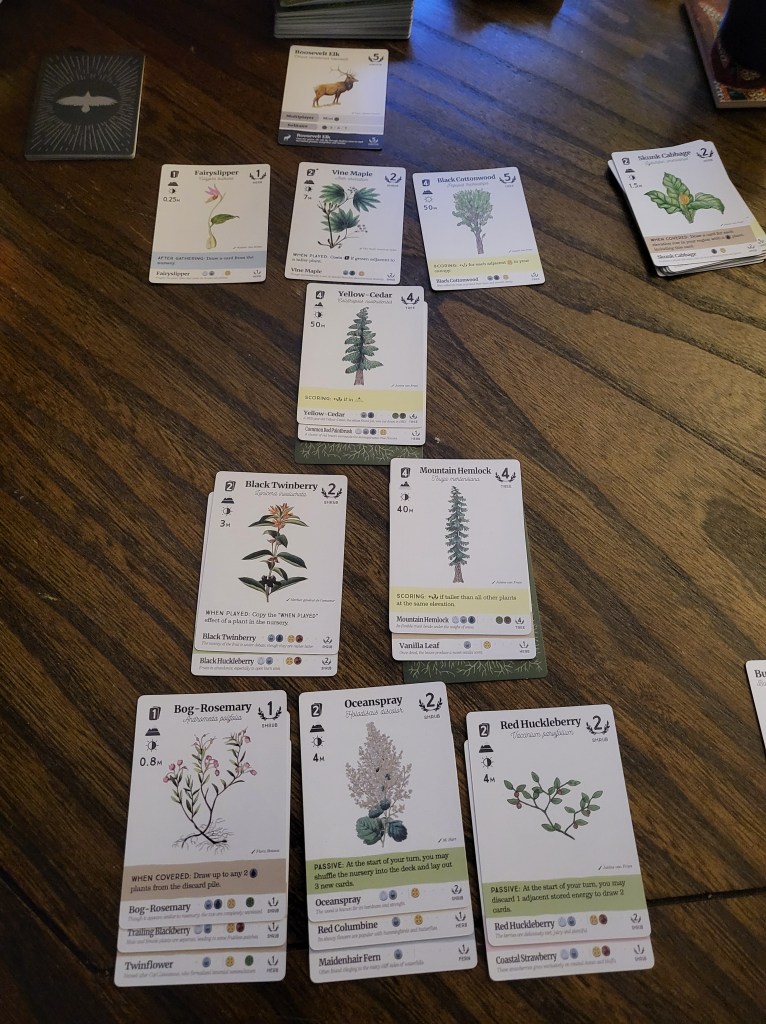
While being a pretty simple game mechanically, there are a lot of deep, fun, crunchy decisions. The theming of this game also ties in very well with the mechanics. Each part of the strategy stems from (pun intended) what each card can do and the height/sun requirement/type of the plant and how they all coexist together in your ecosystem.
Besides the amazing strategic and thematic elements, I also find it to be a highly variable and replayable game. With the number of plant cards and visitors, there is a lot of inherent variability. Also, the plant abilities can combo with different cards in unique ways, so the order in which you draw and play the cards provides constant evolving decisions.
The solo implementation of game play is also incredible. While I haven’t played multiplayer, I could (and have) play this for hours and not get tired of it. The visitors are well “scaled” to have appropriate solo tasks to strive for, and the overall flow of the game is smooth and effortless. I also really like that there is a win/loss condition and not a beat your own score, especially since each game can vary greatly depending on which plants are included. There’s nothing the game does that impacts whether you win or lose, you have to maximize the cards to score higher than the total of all plants you play with. You play the deck against itself and yourself (so meta), and it’s brilliant.
Lastly, I appreciate the sustainability features of the game production. The box is only as big as it needs to be and there is nothing plastic-related. After repeated travel and use, I can see the box and cards potentially getting worn out, but I’ve played twenty plus times now and haven’t had an issue yet.
If you can’t tell, I highly recommend this game. Even if I only ever play solo, every cent I spent on it (which really wasn’t much) will have been worth it. It’s clever, thematic, strategic, fun, exciting, variable, fascinating and overall, just a really enjoyable experience, and it comes in a small, portable box. As a nature lover, solo board gamer, and mid-weight under-an-hour game preferer, I can’t imagine it ever leaving our collection.
 The Adventures of Yogi Bear and Delaware
Leave a comment