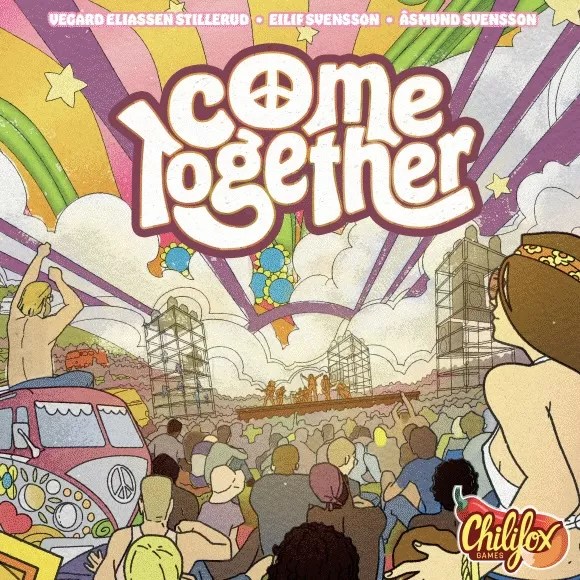
Image taken from https://boardgamegeek.com/image/6893002/come-together
Designers: Vegard Eliassen Stillerud, Eilif Svensson, Åsmund Svensson
Publishers: Chilifox Games, Matagot
Artist: Yan Moussu
Come Together is an innovative worker placement game themed around 1960s music festivals. The game is played over three rounds, and each round you place workers on different locations across the board to eventually gain the associated card. While some locations have immediate benefits for placing your workers (the ones with good stuff cost more), you don’t receive the corresponding card until that entire location is activated. This is what makes this game so clever: in most worker placement games, when you perform the placement action, you immediately gain the reward. Here, you have to wait until someone (doesn’t have to be you) activates that entire location in order to gain the cards your workers are associated with. It’s a fun and innovative twist on worker placement that makes this game unique! While I’ve only played solo, I can see myself enjoying the positive interaction in a multiplayer game.
Each turn you have three options: place workers, activate a location, or take back workers. Placing workers I briefly mentioned earlier, but each location has spots that require 1-3 workers. When you stack the required number of active workers on that spot, if there is a bonus, you gain it immediately. Otherwise, your workers just remain there until that whole location is activated.
Option two is to activate a location. To do this, you place your activation token in the appropriate location (and immediately gain the benefit) and then choose a location where you have at least one worker and gain the cards associated with those spots. Once you’ve taken the card(s), you can either activate each immediately or place them in your planning area for later use. After gaining the cards, you also get to advance on tracks on your player board depending on the number of occupied spaces at that location (not just with your own workers). These tracks help score points and provide bonuses along the way. Each other player with at least one worker at that location also gets to collect their cards and move the markers on their board.
Once a location gets activated, those workers return to the main board next to their hippie bus to be used later. In the third action option, take back workers, you can move all resting workers (those on the board by the bus) on to your player board so they become active workers and can be placed in location spaces. Besides gaining your resting workers, you can also gain another worker from your reserve (if any exist), discard one active worker to perform one full place workers action, or draw three cards from any of the four location decks and choose one to keep in your planning area.
The game continues as such until the end of the round is triggered by reaching a certain space on the activation track (location depends on player count). At that point, you claim any cards associated with your workers in inactivated locations, and then proceed with end of round scoring. There’s also some clean up that happens between rounds; then the next round begins and continues until the end of the third round. Once three rounds have concluded, end of game scoring occurs and the player with the most points is crowned the winner.
There is a specific game mode for two players that involves an additional friend deck. I haven’t played it, but it looks interesting. The solo game works similarly to a two-player game, but the other player is called “friend” and uses that friend deck to dictate their turns. During each of friend’s turns, two cards from the friend deck get revealed to indicate the location that friend places their worker. If at any point, friend would place their third worker (they only use one each time) or the location at which they should go is full, friend activates that location. When this happens, the solo player loses two points (rude), but the rest of the turn is treated as a normal activation. In my opinion, friend is an easy implementation that is very easy to facilitate, but they still impact the game quite a bit for the simplicity; the design is impressive.
There is also an official solo campaign that is challenging and thematic, and significantly increases the replayablility in my opinion. You get to use each of the asymmetric boards, you have different goals, unique challenges, etc. so each game felt different enough. Without it, I probably wouldn’t have played as many times as I did consecutively.
Besides the asymmetric player boards (there’s also a symmetric side), there is also an advanced variant that adds some additional decision making and variability which I appreciate.
I enjoyed this game solo, and I could also see it working at lower multi-player counts. Even though I appreciate games that play more than four players, I could easily see this game dragging at higher player counts. It’s interesting, the worker placement is unique, and the theming and game itself are a lot of fun, but I cannot imagine what the length of a five or six player game would be. It took me close to an hour solo, and I suspect the game length increases proportionally to the number of players. So, if you’re looking for a mid-weight euro that plays up to six players, this does fit the bill but know the game could get long at the higher player counts.
My other main complaint is that the game isn’t highly replayable. There is a lot of inherent variability in the cards, asymmetric player boards, and worker placement activation, but each game still has the same goals and main achievements, so I could see it getting stale if overplayed.
Thematically, this game is integrated well. The four locations and main card types are stage, star (performers), camp, and audience, so you are truly working to combine those four aspects to create an enjoyable experience for your attendees. In theory, the theme could be altered, but I think the design of the game shows they wanted to create a thematic experience.
Come Together is a fun, fresh, unique, thematic mid-weight euro that has a lot to offer. While I definitely plan on playing solo again, I also look forward to trying it multiplayer.
 The Adventures of Yogi Bear and Delaware
Leave a comment