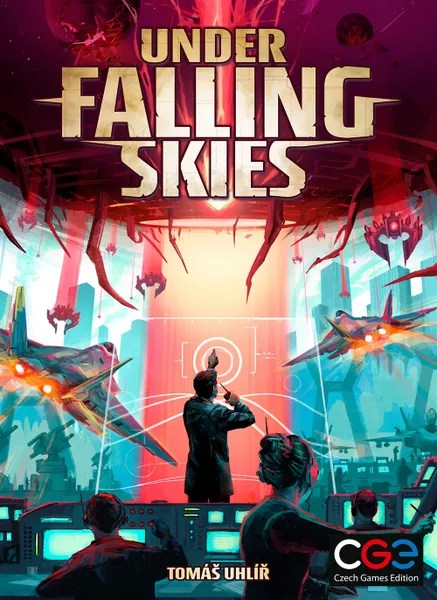
Image taken from https://boardgamegeek.com/image/5428723/under-falling-skies
Designer: Tomas Uhlir
Publisher: Czech Games Edition
Artists: Petr Bohacek, Kwanchai Moriya
Where to even begin. This game is absolutely phenomenal. If you want hours and hours and hours of content at a really good price point with intriguing and exciting mechanics and a campaign, this is the game for you! And I mean, who wouldn’t want that?!
Truly, the amount of play time and content in Under Falling Skies is astronomical (pun intended). Playing regularly, it took me about six months to finish my second campaign, which means I had officially used everything in the box at least once (most only once). But that’s the thing – so much of it can be used hundreds of times! Literally! The sheer number of combinations of the cities, people, scenarios, difficulty levels, tiles, etc. is insane. If I play this once every few months for the rest of my life (and I’m only 28), I genuinely think it’s possible I could never have the same setup for a game twice. Besides the incredible replayability, the game play and mechanics are supremely well designed. The game plays quickly, logically, and is a lot of fun!
Before I keep rambling about how astounding this game is, let me give you a short rundown of gameplay. Under Falling Skies is a dice placement game. The goal is to reach the top of the research track before the aliens descend and destroy the city.
At the start of each turn, you roll five dice (reroll options available) and place one in each column on the board. Each column must have one and only one die unless the rules state otherwise. Where you decide to place each die is the tricky (and exciting) part. Each column has different types of rooms available for you to place the dice, and as you progress through the campaign, new types of rooms are added. To avoid spoilers, the main types of rooms are energy, research, and gun rooms. Once all dice are placed, you perform the action in each room where a die is placed in any order you choose. The energy rooms give you energy (naturally) based on the die value (energy is needed to perform other actions). The research rooms allow you to move up on the research track, and then the gun rooms let you shoot down enemy ships. For all rooms, there are more specific rules on how they work and limitations, but I’ll spare you my explanation and let you find other reviews and playthroughs for that.
This may seem easy and straightforward, but there’s one other part to the dice placement that’s very important. There are a certain number of enemy ships in each column. When you place a die, you move all enemy ships in that column down the number of the value on the die. As they get closer to the city, they can trigger actions on squares they land on, and they could eventually cause damage to the city and lead to defeat. So, the decision-making and core strategy of this game is balancing success in terms of getting energy, moving up the research track, and shooting down ships while also trying to keep the ships from hitting the city. Besides the attackers, you also have to watch where you place the dice based on which rooms are available. As the game progresses, you use dice to move the excavator to open more rooms. If a room has yet to be excavated, you cannot place a die there. After completing the rooms phase, the main mothership descends causing even more chaos (typically more ships, moves your excavator back, or moves you back on the research track).
The beauty of this game comes from the enjoyable, intense, immersive, active, satisfying, craveable experience of strategizing, playing, and (hopefully) surviving. The more content that gets added/the further you get in the campaign, the more there is to think about, there’s an increased number of decisions to make (and usually more options to choose from), the necessary balance is more difficult to maintain, and the easier it is to lose (in my opinion).
I find the rule book is well written and easy to follow and understand. Each new section of the campaign provides all the information you need to play the new scenarios with the new content. The flow of the game (both in one game and as you work through the campaign) is expertly designed. Nothing feels out of place and it all coincides with the theme to create a very cohesive gaming experience.
After I learned the base game, I started working through the campaign. Every time I started on a new part of the campaign, I felt like I was opening a gift on Christmas! They’re packaged well and there’s a little comic for each one that connects to the overarching story. One other small thing: each section of the campaign has new pieces added to the game and they’re all well labeled. The punch-out sheets are even color-coded by chapter. For an organizational freak like me, it’s primo. 👌
My only small (very small) qualm is the box size and lack of organizational assistance in the box. The components are pretty well made, but there’s no way to organize them! They provide two plastic bags to keep up with components during the campaign, but now that I’ve finished, I feel like I’m just shoving cardboard in bags and trying to arrange them so they mostly fit in the box. *Sigh* But, obviously don’t let this stop you from buying and trying!
 The Adventures of Yogi Bear and Delaware
Leave a comment