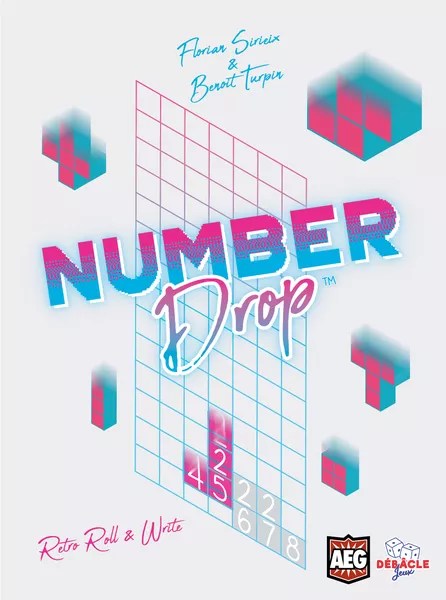
Image taken from https://boardgamegeek.com/image/7490057/number-drop
Designers: Florian Sirieix, Benoit Turpin
Publishers: Alderac Entertainment Group (AEG), Debacle Jeux
I’m not saying this game is amazing, but I do think the BGG rating is lower than it should be. I find it to be a unique and interesting puzzly game, and I think more people should give it a try. In the solo version of this game, you roll five dice – one with a shape and four with numbers. The shape indicates the shape that needs to be put into your grid puzzle, and the four numbers are those that need to be placed in the four boxes inside the shape.
The goal of the game is to score as many points as possible by filling rows, getting the same numbers next to each other, and getting runs of numbers adjacent to each other. The tricky bits: the shapes have to be “dropped” from the top, so you can’t fill in missing boxes unless it’s unblocked, and you can only use each number once in either a set or a run (as in you can’t use a one for a set of ones and the start of a run). Also, in the solo game, there is a separate board that has one tile of each shape on it. With each roll, you choose one of those tiles to lower one level, and if you roll a wild on any number dice (represented by an asterisk), you also have to lower the tile for the shape you rolled. So at least one gets lowered each round. In some way, this keeps the timing of the game in check. There’s a way to trigger the end game on your grid, but once the last tile drops to the bottom (each moves a total of four times in the game), the game ends. The tiles also cause a little tension in the game because if you don’t complete certain patterns quickly enough, then a shape of Xs gets added to your grid. That helps with filling rows, potentially, but they can never count as any numbers.
I’m a little partial because I was a math major in college, but I love the fun puzzle this game offers. It’s both spatial in terms of the shape placement and arrangement, but there’s also another layer of strategy in terms of where to place the numbers in the shape. Additionally, there’s the question of when to circle the numbers in a run or a set.
As a fan of roll and writes and math, there’s little reason for me to dislike this game. It’s not perfect and it’s not one I could continuously play, but for a quick, fun, interesting, thinky puzzle that doesn’t take a lot of space or a lot of time, it’s perfect!
 The Adventures of Yogi Bear and Delaware
Leave a comment