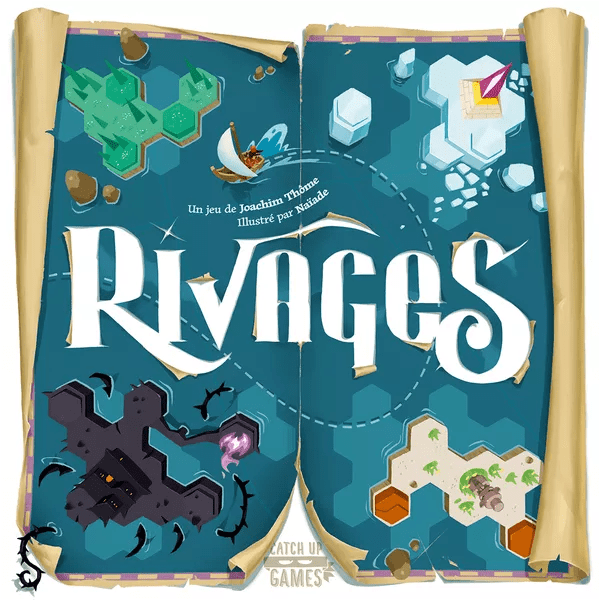
Image taken from https://boardgamegeek.com/image/7923094/rivages
Designer: Joachim Thôme
Publisher: Pandasaurus Games
Artist: Xavier Gueniffey Durin
Rivages is such a pleasure to play! In the first week of owning it (this past week), I played over fifteen times. 🙈 It’s just so quick, fun, and beautiful!
In Rivages, you are exploring islands with the goal of collecting scrolls, which are your victory points at the end of the game. In the multiplayer game, each player starts with one island map (there are a whopping 25 different maps which is incredible for replayability) in which they select one of the two ships (icons on the map) to be their starting location. Then, each player gets two exploration cards, chooses the topmost available row from one of the two cards, and crosses off the matching hexes on their map. The symbols on the exploration card can be used in any order, but each hex you mark on your map must be adjacent to a previously marked location. If you cannot or choose not to use a row from one of the cards, you can mark any one adjacent spot on your map. Once each player has completed their turn, they pass those two exploration cards to the player on their left (in the two-player game it’s just a swap), and play continues. If a card is passed that is fully completed, that player draws a new exploration card to replace it.
While the mechanics of this game are overall very straightforward, there are a couple interesting details that add more strategy. For example, some exploration cards have symbols instead of colored hexes, and each map has certain icons in hexes that can be crossed off following the usual rules (if the background is white, any color can be used). The spyglass symbol allows you to legally mark any hex on your island map. The bag icon allows you to gain a “loot token” which can be played at any time during your turn (they give extra little bonus actions or scrolls), but you can only use one per turn. The statue symbol relates to the other board each player has: the Tree of Wisdom board. When you mark off a statue, you get to cross off a space on your Tree of Wisdom board. Some of these spaces offer benefits, but just as on the map, there is one starting point, and each new mark has to be connected to a previously crossed off spot. There are five different Tree of Wisdom boards, and each has an A side which is identical to all others, and then a B side which are all asymmetric in their patterns and rewards.
Each map has one quest and two exploration missions which are goals you can work to achieve; they’re optional but often provide scrolls and other goodies. Typically, missions require you to have a certain number of completed groups of a terrain type (ex. one fully marked group of red hexes), and the quests usually involve reaching specific locations on the island.
The last main mechanical addition to this game is gaining new islands. To draw a new island sheet, you must reach and mark off the second ship icon on your current island. At the start of the next turn (not during your turn), you get to then set aside your current island and get a new map sheet. There is a bonus for the player with the most visited islands at the end of the game (or top two players in a 3+ player game). There is a solo iteration of this goal as well.
The game ends when a certain number of exploration cards have been used (varies depending on the player count). Each unused loot token counts for one scroll at the end of the game, and the player with the most scrolls wins!
The solo game plays out similarly to the multiplayer but your objective is to get a certain number of scrolls (and potentially other achievements – keep reading for more information) with only eight exploration cards. Not only do you only have eight exploration cards, but the game actually ends when four of those are completed. So, mathematically (I was a math major in college, so I must include this), you have a maximum of twenty turns before the game ends. The standard version of the solo mode is to obtain 26 scrolls, but there are five other solo challenge cards you can add to increase the difficulty. For example, in my last play, I added the solo challenge cards for +4 scrolls, eight completed land terrain types (two of each color), and marking off at least eight spaces on the Tree of Wisdom. The other two challenge card options are obtaining six or more loot tokens and reaching five or more islands (including your starting island). The other main difference when playing solo is that you obviously don’t pass your explorations cards. Instead, you use hexes from one of two exploration cards as normal, then discard both cards. Once all eight (or less) cards are in the discard pile, they get shuffled, and you start again.
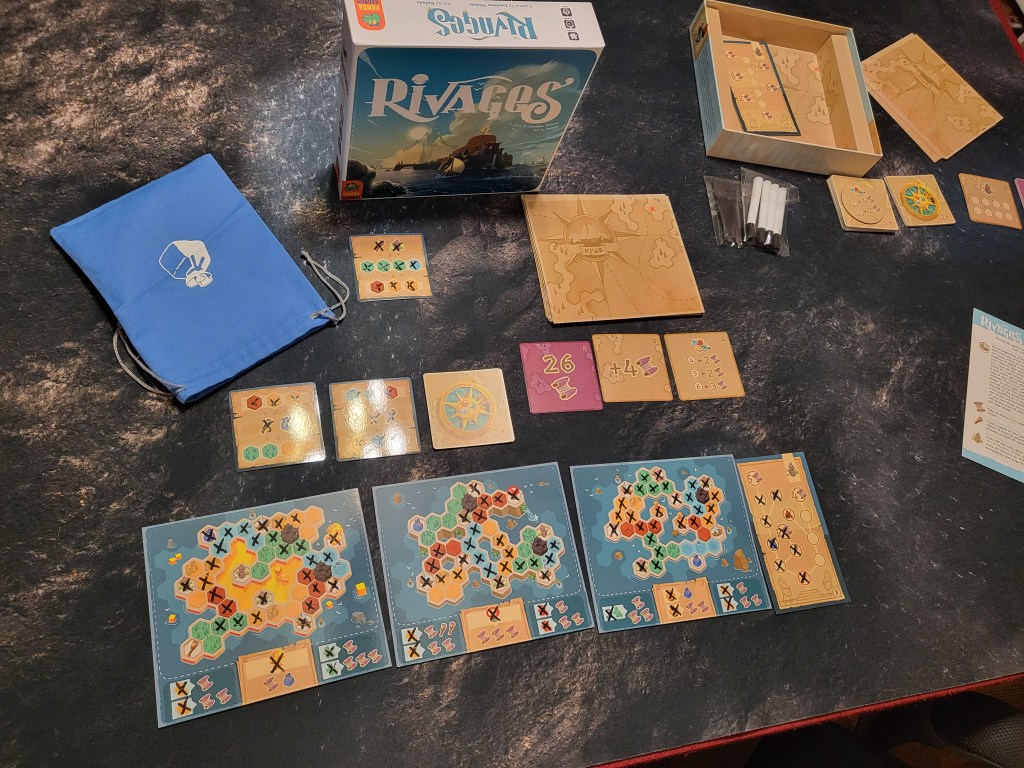
Having mostly played solo, the unique combinations of different islands, Tree of Wisdom cards, and solo challenge cards really makes each game fresh. Yes, the mechanics are the same, but the strategy alters depending on the goals and maps. For me, this elevates this game a lot. It’s easy for blank and writes to get samey after a while, especially solo, and while there probably won’t be another week where I play this much, I do feel I will continually enjoy this game.
I do want to point out that this is mostly a multiplayer solitaire game. While there is some interaction with the passing of the exploration cards, that’s the only way you can affect other players’ turns and maps. The plus side of this is that the turns are simultaneous so there is very little downtime, and the game doesn’t take much longer at higher player counts.
A few other high points for me: I find the art in this game appealing and pleasing to the eye. It’s fun, fitting for the theme, and well designed. I appreciate that this game is simple mechanically and easy to teach but there is still a lot of room for strategic decision making. I also enjoy the number of choices you have to make in the game, and the importance of the timing of those decisions. That’s probably one of my favorite aspects; when do you try to complete more on your current island and when do you move to a new one?
A few non-deal-breaking low points: when playing solo, shuffling the exploration cards with the dry erase marker on them can be a bit difficult. That said, I’ve never had an issue figuring out which spaces have been marked off and which haven’t. “Shuffling” the map boards can be a bit cumbersome as well. There are also a few typos in the rulebook. None of them affect the understanding of the game, they’re just annoying and something that could have been fixed.
In terms of the componentry, the pens have been full of ink and write very well. After about fifteen plays with one marker, it started to dry out some, though, and they leave some bids of residue after wiping off the sheets. The thickness is very suitable for the spaces that get marked. The cleaning cloths are also very nice, and I appreciate their inclusion in the box!
If you haven’t been able to gather this already, I really like this game and highly recommend it. While I admit there isn’t anything particularly innovative about the design or the theme, it’s still distinctive, everything works very well, it plays very smoothly, and it has a lot of replayability in my opinion. I also greatly appreciate the player count range being one to five, as I often play solo, but we also have a gaming group of five people. From our experiences thus far, it’s worked great both solo and at two players, and I imagine it will work well at higher player counts (and it could be more interesting with the card passing). If you enjoy draft and writes that play quickly (roughly 30 minutes) but still have unique strategy with a wide variety of set up and play options, I definitely recommend Rivages! It’s a lot of fun, simple yet puzzly, and I can see it working in almost any gaming group. I’m already ready for an expansion with more maps, more cards, and maybe a solo campaign or achievement list (cough cough designer/publisher).
One random quick tip: I suggest marking each hex on the exploration cards one at a time because there can be some combo wombo turns, and it can be easy to lose track of how many hexes or items you’ve used on those cards. Not that this has happened to me or anything…
 The Adventures of Yogi Bear and Delaware
Leave a comment