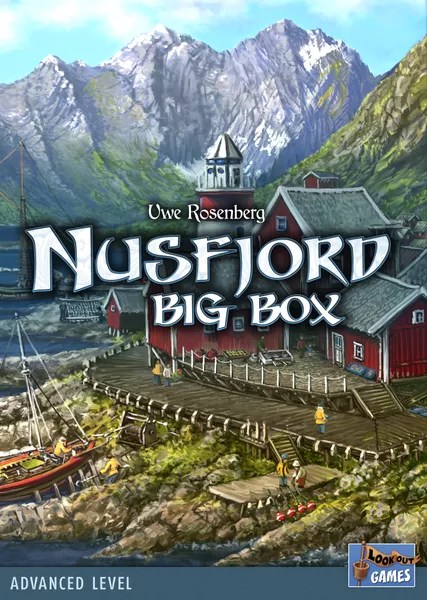
Image taken from https://boardgamegeek.com/image/7978202/nusfjord-big-box
Designer: Uwe Rosenberg
Publisher: Lookout Games
Artist: Patrick Soeder
Disclaimer: I have never played the original Nusfjord so this will not have any comparisons. This is just a review of the Big Box as it is!
Nusfjord is a worker placement and resource management game that takes place over seven rounds. Each round you have three (and only three) workers, so this game is very much an optimization puzzle of how to use your limited workers and resources to get as many points as possible. In the solo game, you still get three workers per turn, but you play as two colors, so rather than vying with a fake opponent for worker placement spots, you’re actually playing against yourself. I won’t go through each mechanic and worker placement action spot, but hopefully this provides an idea of how the game flows and why it might be for you. For me, this game is the epitome of a quick, medium weight euro, and it’s amazing.
Truthfully, the multiplayer game is identical to the solo game except it is very possible a spot you need gets blocked by your opponent (or you can block one they need). Besides that, there is minimal player interaction except for the ability to own shares in other players’ companies (and gain money from them). The rest of the game plays out as a multiplayer solitaire experience.
In the solo mode, as mentioned, you play as two colors, and each round you rotate which color you play (ex. round 1 is red, round 2 is blue, round 3 is back to red, etc.). The worker markers of the other color remain on the board to block spaces, so you essentially block yourself with your own workers. This mechanic creates a massively fascinating puzzle. How do you use each set of workers to maximize each turn while not blocking too many of the spaces you will need next turn? And which order of placement will be most beneficial to maximize points?
There is a unique campaign mode with the solo game that allows you to play through all the decks and really experience each deck and what it has to offer. For reference, each deck is made up of different buildings that have specific costs, benefits, points, etc. so each deck brings a solid bit of variability to the game. The campaign is played over three games, and once you’ve used certain buildings (as in built them and were on your player board), those cards get removed for the remainder of the campaign. This design choice adds an extra layer of strategy and planning. Do I build this now because I need its bonus and/or can afford it, or do I save it for when I can potentially combo it with another building? The campaign is also designed for you to see as many buildings as possible, so you get a good feel of what makes each deck special and unique.
The solo mode also has a more challenging variant where you use three colors instead of two, so you have even more worker placement spots covered. After having played through each deck at least once in a standard campaign, I am definitely looking forward to playing some decks again with this added difficulty. I can only imagine how much more puzzly it gets!
For the solo mode, I find the design impeccable and the amount of variety that comes in the big box is fantastic. It includes all previously released expansions (as well as what was in the original base game), and it adds two more expansions. This makes for a total of seven different decks to play!
In terms of each of the different decks, I found that the Herring and Mackerel decks were very good for my early learning games, but as I played other decks, they got a little less exciting. I found the Salmon and Plaice decks to be towards the lower end of the middle of the pack, and the Trout and Codfish decks to be on the higher end. My absolute favorite deck is the Besøkende deck (AKA the guest deck). This deck adds guests to the game which adds another whole layer of strategy to the game. The necessary level of thought and planning increases making the game even crunchier and more satisfying. The first time I played this deck, I got crushed, but I had SO much fun. The second time, I still did not reach the required score to successfully complete the campaign, but I definitely improved!
From my experiences thus far, I enjoy playing solo more than at two players. The two-player experience was more frustrating and there seemed to be less of a puzzle than the solo mode. I like that I have complete control over the board and all my actions in the solo game (I might just be a control freak 🤷♀️). If I lose, I planned poorly; it wasn’t because someone took the spot I needed.
Overall, Nusfjord has great mechanics, a nice theme, lovely art, and a fantastic solo mode. The Big Box edition adds lots more variety and replayability to an already highly regarded game (at least from what I’ve read). For a game with a 45ish minute play time (at two players) and 60-90 minutes for a full solo campaign, there are a lot of interesting and crunchy decisions without mechanics that are overly complicated. I also greatly appreciate the variable player count. Our gaming group is five people, so I look forward to introducing this some time. Also, while the theme isn’t mechanically integrated, everything in relation to the art, actions, resources, and worker placement spots are thematically immersive which makes for a fun fishy time.
Truly, while the cost is a bit high, in comparison to the original game, the Big Box is a significantly better deal. There is so much content, and the components are nice, so the extra few bucks are worth it!
 The Adventures of Yogi Bear and Delaware
Leave a comment