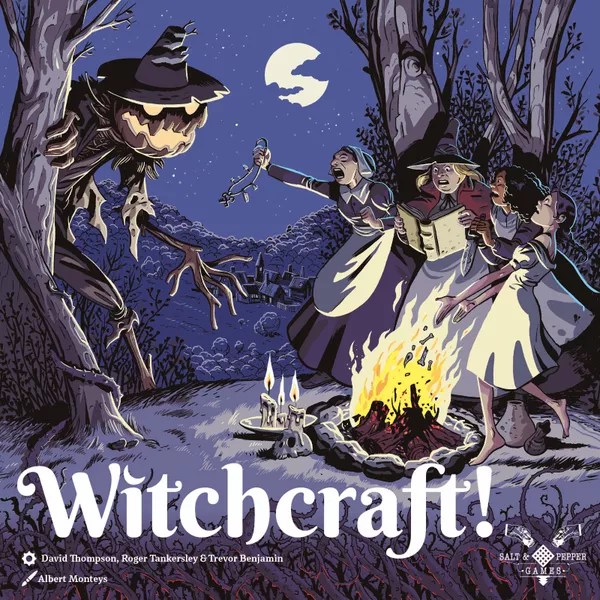
Image taken from https://boardgamegeek.com/image/7442805/witchcraft
Designers: Trevor Benjamin, Roger Tankersley, David Thompson
Publisher: Salt & Pepper Games
Artist: Albert Monteys
Witchcraft! is a solo only board game where you play as witches that have gained suspicion from their community. In the base game, you are working to gain persuasion over three jurors to prevent conviction. To do this, you use your witches to defeat challenges and complete missions. Here’s the first thing I adore about this game (there are many as you’ll soon see): each juror has their own missions and challenges, so each game will always be different, which immediately adds incredible replayability value (always a positive in my book). But wait, there’s more! On top of the inherent variability of the base game, there’s also a nine-chapter story campaign that alters the game significantly. Instead of persuading jurors, you’re working to accomplish specific missions and challenges that progressively increase in difficulty (chapters eight and nine really kicked my booty). For a small box, there is A LOT of game play. It’s all very well designed mechanically and thematically, and it’s overall a really enjoyable experience (especially during spooky season!).
Regardless of which version of the game you play, the strategy for this game begins during set up, which I love. After you have what you need for the scenario/game, you choose your starting witches. To do this, you shuffle the deck and draw two witches at a time, then select one to place in your deck (the Coven deck) and the other goes into a separate pile that you can potentially recruit from later in the game. Each witch card is split in half, with the left side indicating a strength and ability (sometimes) for when the witch is hidden, and the right side for when the witch is revealed. Typically, the revealed side is more powerful, but once a witch is revealed during the game, they go to jail, so you don’t get that card back in your deck (hidden witches go into a discard pile). There are also different families of witches that usually have powers that increase in strength if there are other members of the family in play, so focusing your efforts on selecting those combinations can be interesting. All of this in and of itself creates a unique and fun decision space. The necessary balance needed just from the witches is so clever! Every decision can be painstaking when deciding on the right time to reveal a witch, when to maximize any powers they have, and which family’s abilities to focus on.
Each game you start with a hand of five cards from your Coven deck. There are also three curse cards shuffled in that don’t have a direct negative effect but weaken your deck. You can play any witches you want at that point, but you don’t have to play any. Then you select a mission and the corresponding challenges you want to try to overcome with your hand of witches. Besides the specific challenges I mentioned for each juror/mission, there are also twenty standard challenge cards to add extra variability and difficulty.
Which mission to select adds another layer of complexity and puzzliness. Some missions have more challenges than others, some have success or fail conditions, some have conditions when chosen and when not chosen (those are the really mean ones), so you’re constantly having to decipher which mission seems the most attainable based on your hand of witches. A few abilities in the game let you reveal challenges on the missions, but most of the time they are face down, so you can be really pressing your luck when you make your selection.
When tackling a mission and its challenges, there are a few considerations. First, you lose the game if you fail two missions, so the success of the mission is probably top priority, but the challenges can negatively impact you and/or could need to be overcome before you can defeat other challenges on that mission or the mission itself. Some of the challenge cards provide benefits, so those are obviously helpful, but most have negative effects if you fail them. For example, one can force you to add a curse to your deck, or another can make you put a villagers card in the Lost Souls pile (thematically, how many villagers are affected by your witchcraft shenanigans), or some increase the strength of the mission or other challenges. They’re tough!! Honestly, this game is difficult overall, but in the best way.
There are so many ways to lose in this game! I mentioned that if you fail two missions, you lose, but there are a few other ways (actually, quite a few other ways) you can immediately lose: if there are five or more villagers in the Lost Souls pile, if you have to gain a curse and there are no curses left in the curse pile (there are six total in the game), or if you draw a hand of cards with no witches. In the standard game, you also lose if you don’t convince any of the jurors you’re not a witch, so there’s literally one way to win and about five ways to lose each game.
This whole game is like juggling four balls while riding a unicycle on a flaming tightrope. The game itself mechanically is not complex, but there is so much strategy and so many options and details to consider, it’s incredible. The design of this game, with the mechanics and theme so intertwined, makes this game top notch. First having to select your witches, then using them to try to beat challenges and missions, along with avoiding curses and trying to save the villagers while still trying to keep enough witches hidden so they don’t all go to jail – it’s phenomenal.
If you like this theme, if you like solo game play, if you like a rich, puzzly game experience in a small box with a reasonable time frame, if you like endless replayability, or anything else I mentioned, go pick up this game!!! It’s so much fun and it’s not expensive, and it’s just yeah… it’s awesome.

 The Adventures of Yogi Bear and Delaware
Leave a comment