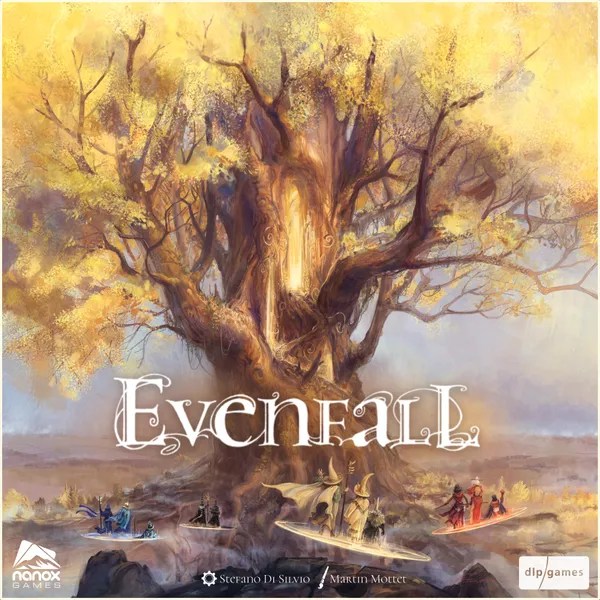
Image taken from https://boardgamegeek.com/image/7657810/evenfall
Designer: Stefano Di Silvio
Publishers: dlp games, Nanox Games
Artist: Martin Mottet
Evenfall was a bit of a splurge buy for us. We went into a game store planning on coming out with one thing but ended up snagging this gem instead (and MLEM – shoutout to MLEM). The store manager indicated that quite a few people had purchased copies, so we decided to go for it, and I’m so happy we did!
In Evenfall, you lead a clan of witches and elders to try to gain the most victory points. In the solo game, you face off against an AI that performs actions and affects your gameplay by taking cards from the deck. Besides that, you’re essentially playing the game solitaire, just with a score comparison at the end. The solo mode has multiple difficulty levels, and the AI is a cinch to run (minus the fact you need some serious table space), so it doesn’t add a lot of time or complexity, which is fantastic. I felt it allowed me to focus on my own strategy, but still impacted the game enough without being too cutthroat (and it kept me motivated to win).
Over the course of three rounds, you use your witches and elders to perform actions, gain resources, and add specialists and council members to your clan. While being a resource management game, the main mechanic here is engine building. You pay resources to play cards and perform actions, but you really aim to build the most productive clan. The unique mechanic is that there is an outer circle and an inner circle in your clan, and you only score points at the end of the game for cards in your inner circle. Throughout the game, there are various ways to move cards into your inner circle, but trying to decide when, how, and which one(s) is the fun part. There are so many options to consider; it’s a really enjoyable puzzle to try to solve without being overly complicated.
The engine-building aspect of this game, for me, is pure magic (pun intended). I can’t tell you how many times (both solo and multiplayer) the first round ends and I feel like I’ve accomplished nothing (literally), and then end up taking fifteen or more turns in the third round. It’s wild. The fiancée can attest; it can be a little harsh in the first two rounds when you feel the opponent is kicking your butt (there was a game he was being so dramatic and then ended up winning 😑), but it’s SO satisfying when it all starts to come together in rounds two and three. The solo game is similar – the AI gets significantly more points in the early rounds, but then you get to blow by them (hopefully) at the end.
Another aspect of this engine building I really enjoy is the importance of action sequence and timing. Since everything can build on each other, there is intriguing decision making in terms of which action to perform at what time and in what order to maximize turns and/or block other players. It adds a puzzle to the puzzle (PUZZLE-CEPTION)!
I realize I didn’t go through many rules, but hopefully this gives a rough idea of the experience. For the solo game, the AI doesn’t affect you too much and is easy to maintain, so you honestly just get to have fun and try new strategies to make the best tableau engine and have the most successful clan. The mechanics, theme, and overall gameplay flow very smoothly and nothing seems unnecessary or superfluous (both solo and multiplayer). The artwork is also GORGEUOUS.
If you enjoy tableau builders, engine builders, resource management, witch themes, and/or adorable meeples (the witches have hats and the elders have beards, what more can you ask for?!), this game is definitely worth a shot. After writing this, I can’t wait to play it again!
 The Adventures of Yogi Bear and Delaware
Leave a comment