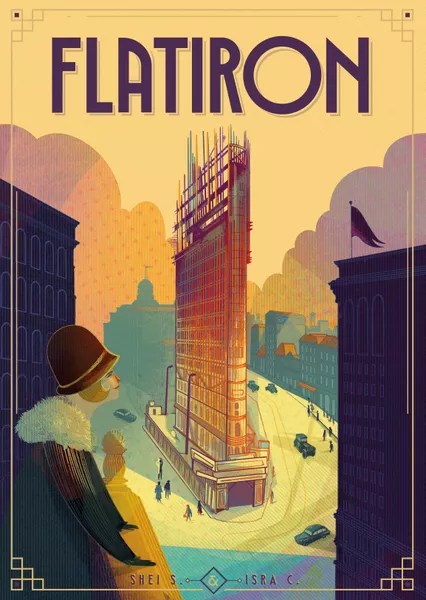
Image taken from https://boardgamegeek.com/image/7926037/flatiron
Designers: Isra C., Shei S.
Publisher: Ludonova
Artist: Weberson Santiago
In Flatiron, you and up to one other person are architects working to construct the iconic Flatiron Building in New York City. Overall, this game is a lot of fun. I appreciate that it’s not super complex and the mechanics are straightforward, but there is still a lot of puzzly decision making. I also enjoy the competitive nature of the game – you can affect and block the other person, but nothing you’re doing is directly malicious. Other things I adore: the game is of good length (hasn’t felt too long or too quick yet), there’s not much downtime, the theme is excellently integrated into the game play and mechanics, the components are nice and very tactile which complements the theme, there are four double-sided asymmetric player boards (therefore eight different configurations), and set-up and take-down are of appropriate length. For me, both in the solo and multiplayer setting, this game is a winner!
On each turn, the active player starts by moving to a new location. There are four locations on the Manhattan board (the main board) and then there is City Hall. Each location on the Manhattan board is a street adjacent to the Flatiron building – 22nd, 23rd, 5th Ave, and Broadway. With only five locations, everything is contained but not congested (unlike the actual NYC), which makes movement easily manageable. The only rules: you can’t move to the location of the other architect, nor can you remain in the same location.
After relocating, you have three options. First, you can just get two dollars (money is always good). The second option is to buy a card at that location. Each of the four streets has a card available for purchase which, when bought, is placed above or below your player board. At City Hall, you can buy a “decree” which scores victory points at the end of the game. Each card (including the decrees) has a top half and a bottom half, both with unique rewards/abilities and a specific amount of reputation (we will come back to this). When you place your purchased card under your board, you choose whether you want the top or bottom half visible. The catch? You can only play a maximum of three cards (including decrees) at each location.
If you don’t collect two dollars or buy a card, the last available option is to activate that street location on your player board. Each location on your player board has two inherent actions. The top always offers the option to buy or sell a pillar (we will come back to this too), and then the bottom half has a unique action based on the board (this is why the asymmetric boards are fun!). If you have not purchased any cards yet, you can do one or both of those actions, always resolving the actions top to bottom. If you have purchased cards for that location, you still work through all your available actions from top to bottom, but now you have more action options. You can always choose to skip actions if needed.
Now onto constructing the building (literally)! The majority of points are acquired through adding pillars and floors to the building. The pillars get purchased from the supply and are stored in your warehouse(s). Using an appropriate action, you move them onto the floor of the structure. Building pillars gives you victory points, and each floor has specific bonuses depending on where you place the pillar. All three pillars on each floor have to be unique colors (four total color options, three total pillars per floor) unless something indicates differently.
Once three pillars have been placed, you can gain points by adding a floor to the building. Each new floor offers unique benefits and/or rules for that “round”, and each floor added means the game is one level (pun intended) closer to finishing. Once there are a total of five floors (including the starting base floor) and a roof, the game ends. Interestingly, the game ends immediately when the roof is added – the other player doesn’t get another turn.
The other addition is the Paper Boy! Every time someone passes the paper boy on the scoring board, they get to select two Newspaper Tokens and decide which to keep and which to pass to the other player. Each token has an action on it that can be performed at any point during your turn, as long as it’s not during another action.
I mentioned that certain actions provide victory points, so most of your points are gained during the actual game itself. However, there are two end game items that provide additional points. The first is the decree cards you purchased from City Hall. The second is your reputation at each location on your player board. Throughout the game, each card you purchase has a reputation value represented by a thumbs up or thumbs down with an associated value (a few don’t have reputation). For each street on your board (scored individually), you tally up the reputation values from your cards to evaluate your popularity. If your total reputation is positive, you gain five victory points, and if your total reputation is negative, you lose three victory points. For a neutral net reputation of zero, you neither gain nor lose victory points.
In the solo mode, you take on Daniel Burnham architect vs. architect. Most of the game play is similar to a regular game with the main difference being that Daniel can move to your location (and gains two VP actually). As usual, Daniel is managed through a deck of cards that outline his location and action preferences. He scores points during the game, and at the end, he adds victory points for the cards (both location and decree) he obtained during the game. While not being one of my top solo game designs, it’s a nice addition so the game isn’t solely two-player. Unfortunately, Daniel only has nine solo cards, so the solo replayability factor for me is rather low, but multiplayer replayability I find quite high.
Overall, this game has a really solid design! The synergy between the simplicity of the mechanics with a pointed theme creates a very enjoyable gaming experience. It’s a great, midweight, 45ish minute game that packs a lot of punch without being overly complicated or a major brain burner. The scoring feels well balanced to me – you gain most of your points during the game, but it’s possible to catch up at the end if you have the right decrees and reputation. For the cost, I appreciate that the components (especially the pillars and meeples) are well made, and I also applaud the amount of game included, as it has a lot of inherent variability with the different floor tiles and player boards. Other than my gripe with the solo game, my only other small complaint is that I wish there were player aids with all iconography identified.
If anything I mentioned in this review is appealing, I would definitely suggest giving this game a try! I was pleasantly surprised with the experience and look forward to more plays!
 The Adventures of Yogi Bear and Delaware
Leave a comment