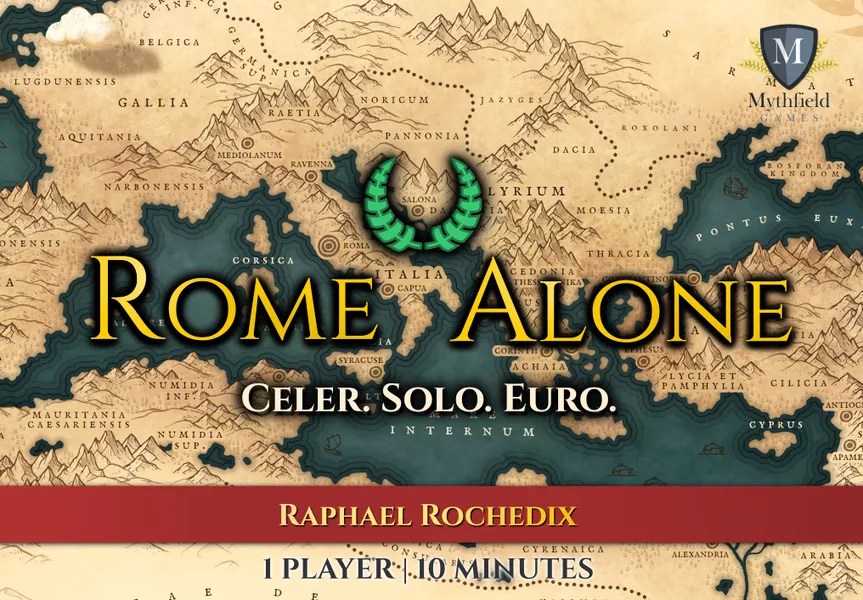
Image taken from https://boardgamegeek.com/image/8252862/rome-alone
Designer: R. Rochedix
Publisher: Mythfield Games
I’m just going to start by saying I am quite impressed with this game (probably in my top ten solo games currently). Not only is it an enjoyable gaming experience with smooth mechanics and a great theme, but it also plays exceptionally quickly and there are two branching campaigns in the game. And it’s in a small box that everything easily fits into!
In Rome Alone, you are working to gain Glory Points through resource management. Each game has three rounds, and in each round, you work through a deck of cards to gain resources, construct buildings, conquer cities, and build monuments. To achieve this, you draw three cards at a time and choose one to either gain resources from or to use as an action. If you choose one for resources, you gain those immediately and then all three cards get discarded. Otherwise, you follow the text on the card to perform various actions. To conquer cities, you pay resources and place a cube on your map “mat” (large card). For buildings, you pay the required resources and then place the building in your “build area”. Since this card gets placed in that designated area, it does not go into the discard pile and, therefore, you will never redraw that card – it remains in the build area until the end of the game. The final action option is to contribute to monuments. This is similar to buildings in terms of spending resources, but the card goes into your discard as normal rather than being removed from the deck. Each monument also requires two build actions (represented by placing two separate cubes), so if you only place one cube, it doesn’t get to be scored at the end of the game, nor can you use any in-game benefits until it’s fully constructed.
The joy of Rome Alone is that it’s not complicated in the slightest, but there are still a lot of fun choices and strategies. The resource management, combined with card usage and timing – everything works really well together and creates a unique and fascinating puzzle.
The two campaigns (one is Rise of Rome, one is Fall of Rome) are branching, so the starting card is the same (but different for the two separate campaigns), but there are unique paths to the end that are contingent on how well you play. Both have four stages, and you can lose along the way, but each card has specific win conditions and/or special rules for that game. I really like campaigns anyways, but the branching makes for high replayability, and these are well done and integrate well thematically. They’re also challenging enough without being unbeatable, and still exciting because you can try new strategies and the game play can be different.
I’ve played the Rise of Rome campaign twice, each with different outcomes, and I have yet to make it to stage four on the Fall of Rome, so I still have a lot of work to do! I love how easy it is to set up, play, and take down, and it doesn’t take up a lot of space on the table. Typically, I’m a really slow gamer (meaning the printed time on the box is usually at least 15 minutes faster than my play time), but this game is truly a 10-15 minute game as advertised. For a quick, small, exciting solo game – Rome Alone is a fantastic choice! 10/10 would recommend!
 The Adventures of Yogi Bear and Delaware
Leave a comment