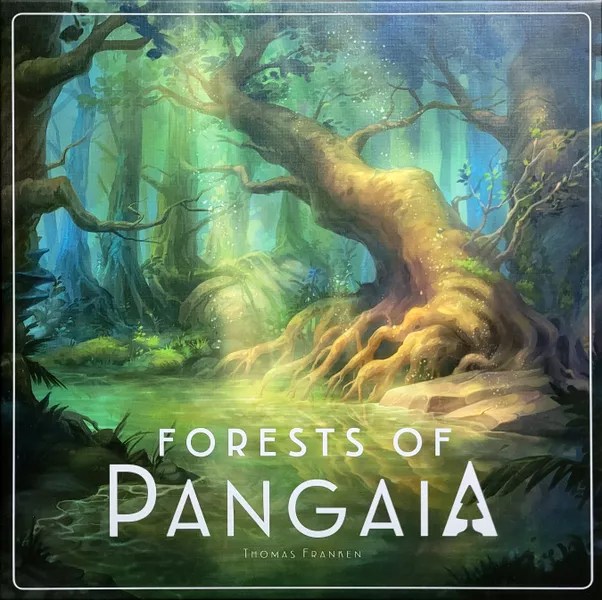
Image taken from https://boardgamegeek.com/image/7421954/forests-of-pangaia
Designer: Thomas Franken
Publisher: Pangaia Games
Artists: Marcel Domke, Chris Karbach, Anna Meshchanova
Forests of Pangaia is a tree growing, forest protecting game, and in the solo mode, you’re facing off against a Corrupted Spirit. Instead of trying to maximize points, you are working to restore the Spirit to its former health. Because I have not played multiplayer, there was a bit of a learning curve initially, but I’ve really enjoyed my time so far! There are some interesting decisions to make, and there is also a lot of predicting what the spirit will do and planning accordingly, which is different than most games I play. I’m usually not a huge fan of defensive game play, but with Forests, it feels more thematically relevant and by playing defensively, you’re not eliminating strategy or offensive play options. You just have to tweak some actions and use forethought to try to keep the Spirit at bay. It’s interesting, I like it. I also adore the components (they’re fabulous – Kickstarter version), the theming, the color scheme, and the logical game flow. Like I said, it took me a bit to learn, but once you play a game or two, the design and mechanics make a lot of sense and complement each other well.
The setup for a solo game is similar to a two-player game, but instead of setting up the Corrupted Spirit’s board as a normal player, you actually leave all treetops and seeds off the board. To win, you have to “bind” all the treetops to the board and gather the associated Seeds of Evil (three of four total). The other main difference is the main board set up. Each land in the solo game has Land Energy that keeps it alive and fertile. It’s possible for the Corrupted Spirit to poison (corrupt) the land during the game, and if too many spaces are corrupted you lose the game. You cannot add any of your own seeds or trees to Land once it’s corrupted.
The game is played over a series of rounds. The Corrupted Spirit goes first every round. For their turn, you flip a card from the weather deck (AI deck). On one side of each card is a symbol for one of the four Land types. On the other side is an action the Spirit performs. So, when you flip a card, the Spirit moves to the Land type on the card on the top of the deck (this way you don’t know where it’s going next). If the Spirit does not move (or cannot move) or if the Land space it moves to has more Corrupted trees than healthy trees (your trees), the Spirit corrupts the Land. This can only happen two times before the Land itself is completely corrupted. After that, the Spirit takes the action on the back of the card that was just flipped. Some of these actions are worse than others, but let me tell you, when it rains, it pours (pun intended). 🌧
Then it’s your turn! As in the multiplayer game, there are three parts to your turn: grow seeds, take a Spirit action, then grow treetops if desired. Growing seeds is as expected: trees grow from planted seeds that don’t have to compete in their environment (and new trees give you resources). Growing treetops is also logical; you can spend resources to add treetops to any planted tree that is yours.
For the Spirit action, you have a few options. You can plant seeds, gain resources, or perform rituals. There is also the added action in the solo game of healing the land (piggybacks on planting seeds). When you choose to plant seeds by traveling to a Land space, you can spend life points to heal an adjacent corrupted Land or add more Energy to try to prevent corruption.
The gaining resources action is pretty self-explanatory.
Rituals are the conduit for scoring points, and in the solo game, the only opportunity to bind the Corrupted treetops and seeds. During a ritual, trees are “used” to perform the ritual which gives you life points and decays all trees involved. If you decay a Corrupted tree with a treetop, you remove the top and pay resources to bind it to the Spirit’s board. To win, you have to bind all six of the Spirit’s treetops to its board. As you add more, you also get to bind some of the Corrupted Seeds of Evil which prevents further Corrupted tree growth. Once a seed or top is bound, it cannot be used/played for the rest of the game.
One downfall in the solo mode is the amount of luck involved and how success is often very circumstantial. The rituals you get, the location(s) of the Corrupted Spirit’s trees and treetops, the setup of the board, the weather, etc. all play into this. Don’t get me wrong, this does provide a lot of variability in play and strategy which is really nice for replayability purposes, but some (most) games are very difficult to win. The difficulty itself isn’t necessarily a negative though! Another small complaint is that a few rules are a little vague. Truthfully, I typically just make my best guess or use the ambiguity to my advantage, but it can be slightly frustrating.
Despite my few complaints, I quite enjoy this game. It’s fun, pretty relaxing (the art and coloring help with this), but still complex and thinky enough. It’s a lot of speculation, but the more you play and understand the rules, the easier the planning and strategizing gets (or the more challenging it gets when you realize how many different possibilities there are in just one move). I also like that it’s a win/lose game based on success and not just a game of getting your highest score or getting more points than the AI. It’s rather refreshing!
 The Adventures of Yogi Bear and Delaware
Leave a comment