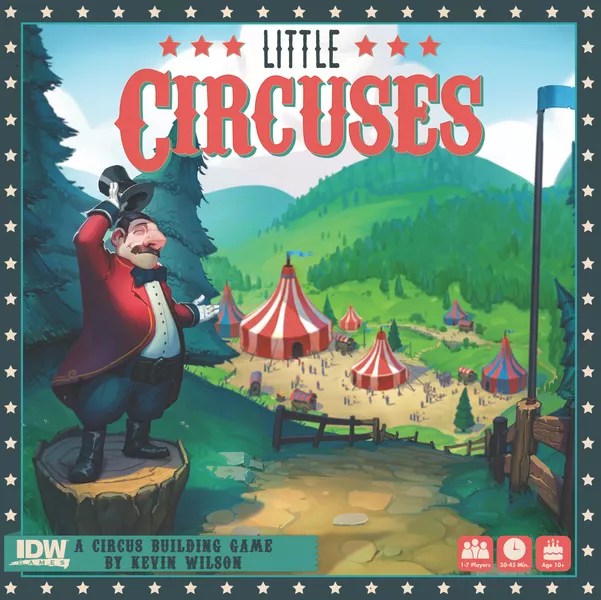
Image taken from https://boardgamegeek.com/image/3507675/little-circuses
Designer: Kevin Wilson
Publisher: IDW Games
Artists: Hector Amavizca, Baldi Konijn
Evidently, a friend of my fiancée bought this game years ago for literally $8 and never played it. We (really he, I wasn’t in the picture yet) ended up acquiring it and still left it unopened. A little while ago, we decided to go through our games to try to see which game(s) we needed to get rid of (I’m looking at you, Friday…) and/or see how many we haven’t played together. This one obviously landed in the “haven’t played” stack, and I saw that it plays 1-7, so I decided to step right up (pun-intended), crack the seal, and try it solo.
First off, someone’s GOT to get a peppy play through up on YouTube ASAP. I think I found two rather dull videos which taught me the game (kinda?), but automatically made me think I was not going to enjoy it. Like I legitimately went into it thinking I’d play it once and be done forever. Even as I was reviewing it later with the fiancée, he said it seemed like I wanted to not like the game. Lucky for me, that was not the case!
After I got through the ridiculousness of punching out and shuffling all the tent tiles, I was able to set up the game pretty easily. The components are decent, and the rule book is straightforward. It’s not great, but it gives you the information you need to play (except for if the double-colored tiles count as both colors or if you have to pick one color?). The tile-laying gameplay, components, and board movement are all very thematic and well done. As the name implies, you are a travelling circus, and you are trying to get as much fame (points) as possible.
On each turn, you start by moving the ringmaster one space on the board. When you land on a spot with a giraffe (it’s really a wagon, but the giraffe is all I care about 😍🦒), you have a “full day” of actions. A full day consists of two parts, a building/preparation phase and performing/action phase. In the building phase, you can either gain two coins, draw a tent tile, or play a tent tile by paying its cost and laying it adjacent to another tile. For the performing phase, you get to gain the benefits on one of your placed tiles. These include a myriad of things such as getting money, getting fame, drawing tent tiles, getting more people in your audience, etc. Once both of these phases have occurred, the ringmaster moves to the next circle on the board. Keep in mind that once you have used a tent tile in the action phase, you place a token on it blocking you from using it again (only for a while, as we will get to soon). Thematically, you can’t do the same performance in the same city twice. When deciding which tile to perform on, you also have to consider that each tile you use for its actions has to be orthogonally adjacent to the tile you just used, essentially making a train 🚂 of tiles that have been used and then blocked. This really impacts where you decide to lay tiles and where you decide to start your actions.
When you land on a spot with a dude with a cool hat and a megaphone thing (I’m honestly not sure of the name), that’s considered a half day meaning you can only either do one thing from the building phase OR use one tile in the performing phase.
Those are most of the turns but there are a few other spaces you’ll notice. The teal tent spot means you shift from using the red beginner tents to the more advanced teal tents. When you land on a space with a shadow figure, you get to choose a card with a performer (or the game calls it, a star attraction) that gives you some sort of benefit you can use either immediately or for the rest of the game, depending on the ability. The last is a city space, where the circus has entered a new city. When this happens, you get to remove all tokens blocking the action tiles you used this round so they become available again. New city = new people to perform for! As time progresses, you get fewer full days and more half days, which can require some planning ahead.
At the end of the game, you get points for sets of different colored tiles you have laid, any extra tiles each count as one point, sets of three money count as two points each, and then remaining audience members can also give you points. I realize I didn’t talk much about the audience members, but they’re pretty straightforward. Some actions in the game allow you to increase their value (make their seats better?) and then you can use other actions to either get fame by “wowing them” or money by “making a big sale”.
Like I said, I was not expecting to like this game, but I actually really enjoyed it! I’ve played it multiple times just to try different strategies and see how that impacts my end game scoring. Unfortunately, beyond beating your own score, there isn’t much that leaves me desperately wanting to come back for more, but there is a fun chart at the back for solo score comparison (I still haven’t reached the highest level on the Fame-O-Meter yet). Each game also feels different just based on the sheer number of tiles available. I feel like I could play multiple solo games and not even see some of the tiles, so that adds some replayability for me.
I’ve have yet to play this multiplayer, but I could see it working well in both capacities. It’s mostly a solitary game since you’re just working to maximize your points, but there are some performer cards that provide interactions with other players (did I mention the cards are double sided?!). This game is also easy to pick up and has a very reasonable (20-30 mins solo) play time, so it’s something I could see making it to the table often enough. Now this game is certainly not perfect, but if you want something that’s quick, fun, thematic, and somewhat strategic without being heavy, this is a great game! The wide range of player counts also lends itself to being a nice addition to any game collection.
 The Adventures of Yogi Bear and Delaware
Leave a comment