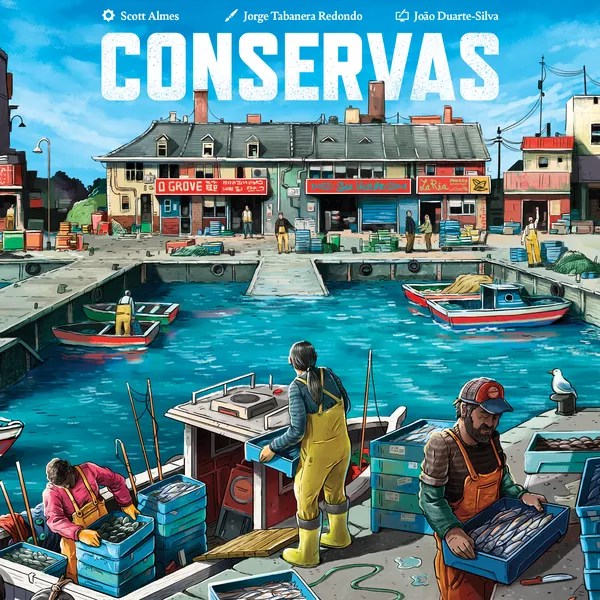
Image taken from https://boardgamegeek.com/image/7884933/conservas
Designer: Scott Almes
Publisher: SaltandPepper Games
Artist: Jorge Tabanera Redondo
OMG, I LOVE THIS GAME. Conservas is the first thing I ever backed on Gamefound and I am so happy I did! I adore the game, and the added Gamefound scenarios and cards are amazing. All
components are well-made, and the artwork is very nice and ties in harmoniously with the theme and gameplay. The box is an appropriate size, and everything fits well inside. The design is exceptional, and the game flows well. The rule book is well organized and easy to understand. It plays quickly but still has depth. As you can see, there’s a lot to like! I’m also a sucker for conservation promotion. 🌎
To set the scene, you are a fisherman, and you need to make money while not overfishing the sea. To do this, you go out on your boat, get fish, and come back to port to sell them. If they stay in the sea, they spawn and produce more fish. Mechanically, this is all represented by bag-building. Along the way, you can also buy more boats and get upgrade cards that can help you in various ways. But one thing to note: this game is all about balance.
First off, I greatly appreciate the number scenarios there are to play! The Gamefound campaign provided three extras, but even the book of twelve (one for each month of the year) is a lot of
content. Each one also has a “standard” and a “difficult” end goal, so that can be up to 24 different games (30 with the extras). I love the creative design of the book where it’s an ongoing story and each little snippet about what’s happening that month is reflected in rule changes and/or market changes. Each scenario also has different starting money amounts, your initial bag makeup is unique, the number of rounds can vary by scenario, the market setups are specially designed, AND the win conditions for each are tied to the story. It’s truly ingenious. The extra three scenarios are also a great addition. Some increase the challenge level (cough cough Summer Holiday) and overall fit into the story seamlessly.
Once you’ve selected which scenario you want to play (I suggest doing them chronologically, especially since January is introductory), you begin with one boat, an open sea card, a certain
amount of money, and a specific bag setup of fish and water chits. Then, you set out three additional boats that are available for purchase and three upgrade cards you can use fish to acquire.
Each boat has a top and a bottom section. The top is for the fish you want to (but don’t have to) sell, and the bottom is for the fish you’re keeping in the water to contribute to spawning. The number of fish you have to (not can) put in the top half to sell varies by boat, so boat selection can play an important part in success. The fish on the open sea card always contribute to spawning.
Each round, you draw five tokens, and all five must either go on the open sea card or on one boat, there’s no splitting a draw. If you choose to put them on a boat, you decide which part of the boat you want certain tokens to be in. This leads to some interesting choices and strategies depending on the goals and your plans.
Obviously, buying more boats is helpful because that means you can sell more fish, but you also don’t want to have too many boats. If for some reason in a round you run out of tokens in your bag before all your boats and the open sea are filled, you add in water tokens until everything is full. The water tokens don’t provide a negative effect, but they’re essentially useless tokens that can water-down (pun intended) your draws to have less fishies. 🐟
At the end of the round, the fish you didn’t sell but were on the top of your boat get returned to the general supply. If you didn’t buy any boats that round, you can choose to refresh all three, and same with the upgrade cards. If you did buy boat(s) and/or acquire upgrade(s), you fill the empty spots with new cards. You also pay boat upkeep for each of your boats, and then your fish spawn and
you start the next round. The fish multiply based on how many of that type (total across boats and sea) are in the water. If you only have one fish, no fish spawn. If you have two, you will get one additional fish. If you have three, you’ll get two additional, and so on. All fish in the water automatically return to the bag, so these new fish are retrieved from the supply.
Even if this seems a little overwhelming, the theme, story, and mechanics are intertwined so well that it all makes logical, contextual sense and everything flows smoothly. The rulebook is well organized and lays out each phase (sea, land, and end of day) step-by-step making it easy to follow and comprehend.
I really can’t recommend this game enough. I think I played at least 24 total hours over the course of a month as I worked through the scenarios. Sometimes the end is gut-wrenching when you think you’ve played well and then end up ONE MUSSEL SHORT of the goal (not that that’s happened to me or anything). Even though I lost multiple times, it’s such an enjoyable game, I wasn’t disheartened and wanted to keep trying. As I said earlier, this game is all about balance, and the decisions this game forces you to make between selling, spawning, and buying are what drive incredible tension, joy, and serious deliberation.
The mechanics, the theme, the art, the experience, the length, the price, the size, the FUN: Conservas is one lovely little package. Whether it’s one-off adventures or working through the book again, I have BIG plans to continue playing this wonderful and immersive little game.
 The Adventures of Yogi Bear and Delaware
Leave a comment